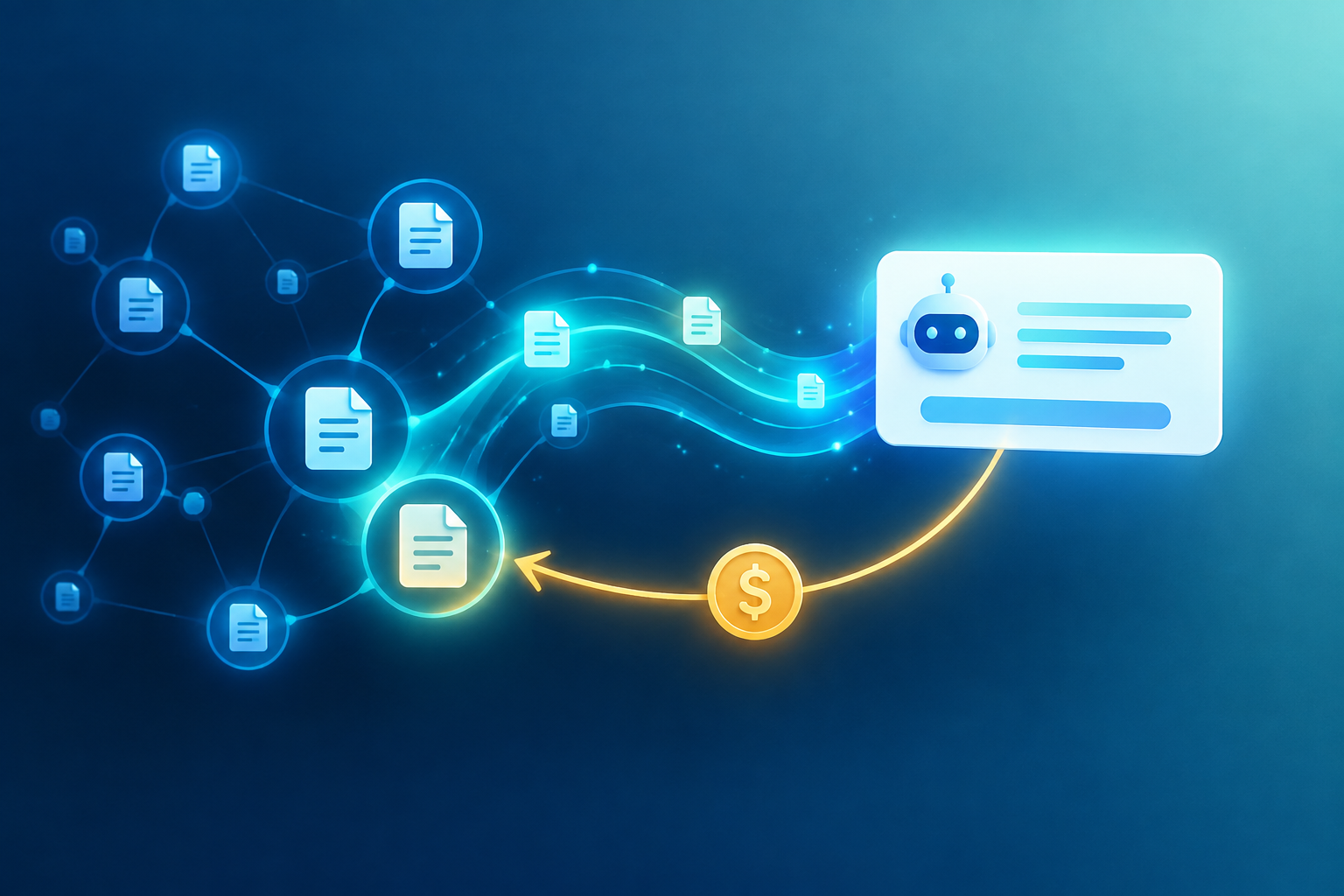
Is “People Also Ask” still worth targeting? Not in its old form. The PAA box that used to quote a tidy FAQ answer is now almost entirely AI-generated, and most of those answers don’t link back to a source page at all. The real target now is getting named as the source inside an AI Overview — a different, harder bar GrowthAgents calls Citation Share.
What Happened To People Also Ask?
For years, PAA was the realistic entry point for small firms. Write a clean, specific FAQ answer, format it well, and Google’s algorithm might quote it directly in the expandable box under a search result. No huge domain authority required. Just a well-structured answer to a real question.
That mechanism has largely been replaced. PAA questions still appear, but the answers underneath them are increasingly generated by Google’s AI rather than pulled and quoted from a specific page.
By August 2026, that number had jumped to 86%. Separate data from Saeed Khosravi’s Also Ask Miner shows PAA became fully AI-generated starting that same month. One week into September 2026, the figure hit 97%.
Google’s own October 2026 webmaster report, published October 1, confirmed what the third-party data was already showing: PAA answers are now “almost 100%” AI Overviews.
Why Does This Matter For Small Firms?
PAA used to be a lower-competition lane. A firm without a big content team could still win a question box by answering one question clearly. That lane hasn’t closed — it’s changed shape.
An AI Overview doesn’t quote a page the way the old PAA box did. It synthesizes an answer and sometimes credits a source, sometimes several, sometimes none. Getting credited now depends on whether your page reads as the most specific, well-structured answer available — not whether it’s formatted for a snippet box that barely functions the old way anymore.
What’s The New Win Condition?
Call it Citation Share: the rate at which your firm’s pages get named as a source when an AI model answers a question in your practice area. It’s a harder bar than old PAA, because it rewards precision and authority over formatting tricks.
Three things tend to separate pages that earn citations from pages that don’t:
A direct, specific answer in the first sentence or two — no throat-clearing before the substance.
Structured, scannable content: clear questions as headings, concise answers underneath.
Enough specificity (jurisdiction, process step, timeline) that the answer can’t be mistaken for a generic restatement of the question.
How Do You Write For Citation Share Instead Of PAA?
Keep writing FAQ-style content. Don’t keep judging it by the old standard. Before publishing, ask whether an AI model summarizing your practice area would plausibly pick your page as the source — not whether it fits a snippet box that increasingly doesn’t exist in its old form.
Is PAA completely gone?
The questions still show up. What’s gone is the old mechanism where a quoted answer from a specific page filled the box. That answer is now almost always AI-generated.
Should firms stop writing FAQ content?
No. FAQ content is still the right format for the questions clients actually ask. The bar for what counts as a winning answer has moved — write for citation, not for a snippet box.
How would a firm know if this is working?
Watch search-console metrics for your FAQ and practice-area pages — impressions, clicks, and ranking position for the questions you’re answering. That’s the evidence available to track.
Is this legal advice?
No, this is informational commentary, not legal advice.
Curious whether your firm’s FAQ pages are built to earn citations under the new rules? Run a free check at GrowthAgents SiteScan and see where your site stands.
SB 574, signed by Governor Newsom on September 30, 2026, is the first state law written specifically for how attorneys and arbitrators use generative AI — not a bar-association guideline, a statute. It requires attorneys to personally verify every citation in AI-assisted filings, restricts what confidential data can go into AI tools, and bars arbitrators from delegating any part of their decision-making to AI. FindLaw and King & Spalding both flag it as a preview of where AI accountability law is headed nationally.
What Does SB 574 Actually Require?
The law adds a new Business and Professions Code section, §6068.1, and amends California Code of Civil Procedure §128.7. Together they require attorneys to personally verify every case citation and statutory reference in a court filing that used generative AI. A filing with an unverified, inaccurate citation can draw sanctions, and the challenged party gets a 21-day window to withdraw or correct the paper before sanctions proceed. The law firm itself is jointly responsible for violations by its lawyers and staff, absent exceptional circumstances — this isn’t a one-lawyer problem, it’s a firm problem. (FindLaw)
What Can’t Attorneys Put Into AI Tools?
SB 574 bars attorneys from entering confidential, personal, or nonpublic information — dates of birth, medical records, financial details, account numbers — into generative AI unless access is restricted to the attorney and others bound to protect it. That’s a meaningful limit on which AI tools are usable for client work at all, not just a disclosure rule. (King & Spalding)
What Does the Law Require Attorneys to Disclose?
Attorneys must disclose generative AI use to the court for documents submitted to it, and must consider disclosure when AI creates content for the public. King & Spalding notes the scope here is genuinely ambiguous — commentators read it as reaching situations where AI contributed to the substance of the work, not incidental use like AI-assisted proofreading. (King & Spalding) What’s clear: attorneys can’t delegate the practice of law to generative AI. It can assist. It can’t replace judgment. (FindLaw)
Does This Apply to Arbitrators Too?
Yes, and the bar is stricter. Arbitrators cannot delegate any part of their decision-making to AI, and must disclose to the parties when they rely on AI-generated information from outside the record. That’s a direct response to concerns about AI quietly shaping arbitral outcomes without anyone in the room knowing. (FindLaw)
Does This Affect Firms Outside California?
Not legally — yet. But both sources frame SB 574 as a first mover, not an outlier. The open questions commentators are flagging — exactly who must verify a citation, how broad “disclosure” really runs, and whether any of this reaches transactional work rather than just litigation — are the same questions every state will eventually have to answer. (King & Spalding) If your firm already has a clean answer to “who checked this citation” and “what did we let the AI see,” you’re ahead of wherever your state lands.
Does SB 574 apply if my firm isn’t in California?
Not directly. It’s California state law, binding on attorneys and arbitrators practicing there. But it’s the first statute of its kind, and the verification and confidentiality standards it sets are a reasonable preview of what other states will eventually codify.
Does the law cover transactional work, or only litigation?
The citation-verification and sanctions provisions are tied to court filings. The confidentiality restriction and the “can’t delegate the practice of law” language are written more broadly, and commentators note it’s unclear how far they reach into non-litigation work. (King & Spalding)
Is this article legal advice?
No. This is informational commentary on a newly enacted statute, not legal advice. Talk to counsel licensed in your jurisdiction about how SB 574 or any comparable rule applies to your practice.
What should a small firm do right now?
Write down, in plain terms, what your firm already does: who checks a citation before it’s filed, what client data is or isn’t allowed into any AI tool, and who signs off on AI-assisted work before it goes out the door. None of that requires new software — it requires a documented habit. Building it now, before a law like California’s reaches your state, is cheap. Rebuilding trust after a sanctioned filing is not.
Your website makes the same kind of claims your filings do — it just doesn’t get checked as often. Run it through SiteScan, GrowthAgents’ free tool: it grades your site across five pages, rewrites your weakest page, and shows you a before-and-after score in about two minutes. No card required.
By Josh Corbelli, Founder, GrowthAgents AI. Published and last reviewed October 16, 2026.
Answer engine optimization (AEO) is the work of making your firm’s pages easy for ChatGPT, Google AI Overviews, Google AI Mode, Perplexity, Claude and Copilot to find, quote and cite. The checklist below has 36 items in 8 groups. Law-firm AI referrals are still small today, near 0.5% of sessions[5], but they are growing fast, and the firms cited now are the firms prospects are shown next.
The uncomfortable fact first: AI assistants send a small share of today’s visits. Three independent datasets put it between 0.17% and 1.08% of site traffic.
Conductor measured 1.08% of sessions from AI referrals across 1,215 enterprise domains and 3.3 billion sessions, May through September 2025[1].
Ahrefs measured 0.17% of visitors on average across 3,000 sites, and 0.56% on sites with fewer than 999 monthly visitors, the size of most small firms (data published February 6, 2025)[2].
Great Jakes, as reported by LawFuel, found AI at 0.47% of sessions on law-firm sites, with 220% growth. The sample size and year were not stated[5].
The case for acting now rests on four numbers, not on current volume.
Growth. Previsible tracked LLM sessions across 166 GA4 properties from 65,249 per month (November 2024) to 644,478 per month (May 2026), a 9.9x increase[3].
Shrinking clicks on the old results. In Pew Research’s March 2025 browsing data, 8% of Google visits with an AI summary produced a click on a traditional result, against 15% without one. Only 1% clicked a link inside the summary[4]. SparkToro and Similarweb put US zero-click Google searches at 68.01% for January through April 2026, up from 60.45% in 2024[6].
Legal queries are exposed. 23.6% of legal queries trigger an AI Overview, and 57.9% of question-style legal queries do (5W Legal AI Visibility Index, April 2026)[7].
Prospects say they will ask AI. In an iLawyerMarketing survey of 1,110 people, 41.9% said they would use ChatGPT to research a lawyer, up from 28.1% in 2025, and 50.1% named any AI engine. This is stated preference, not observed behavior[8].
Visitors who arrive from AI may convert at higher rates, but the evidence is thin. Seer Interactive saw ChatGPT visitors convert at 15.9% against 1.76% for Google organic on one unnamed client site (October 2024 to April 2025). That is one site, and not a law firm[9]. Ahrefs reported AI visitors at 0.5% of its own traffic and 12.1% of its signups[10]. Treat both as directional.
Measurement caveat. Google counts AI Overview and AI Mode clicks inside the “Web” search type in Search Console, so they look like ordinary organic traffic[11]. GA4 can also file ChatGPT visits as “Direct”. Your real AI exposure is larger than the referral report shows.
2. How AI engines choose which firm to cite
An AI engine does not answer your prospect’s question once. It splits it into many sub-queries and cites pages that answer the pieces. iPullRank calls this query fan-out and describes a single prompt expanding into 15 to 20 sub-queries[12]. The example below is illustrative. It was built from that concept and is not measured output from any engine.
Seed query: “best car accident lawyer in Phoenix.” A fan-out could include:
Intent
Possible sub-query
Page that must answer it
Cost
Phoenix car accident lawyer contingency fee percentage
Fees and payment page
Cost
How much does a car accident lawyer cost in Arizona
Fees and payment page
Process
What to do after a car accident in Phoenix
After-an-accident guide
Timeline
How long does a car accident case take in Arizona
Case timeline page
Law
Arizona statute of limitations for car accidents
Deadline page with statute citation
Law
Arizona pure comparative fault car accident
Fault explainer with statute citation
Insurance
Phoenix lawyer for uninsured motorist claims
Uninsured motorist page
Edge case
Rideshare (Uber, Lyft) or truck accident lawyer, Phoenix
One page per claim type
Geography
Car accident lawyer Scottsdale, Mesa or Tempe
Service-area pages with real local content
Language
Spanish-speaking car accident lawyer Phoenix
Language-access section on the firm page
Validation
[Firm name] reviews, Avvo, bar discipline
Reviews, attorney bio, bar numbers
Do not answer a fan-out with 200 near-duplicate pages. Google’s July 10, 2026 guide says mass-producing pages for query variations or fan-out queries violates its scaled content abuse policy[13]. Build one strong page per distinct intent.
3. The 36-item checklist
Each item names what to do and where it belongs. Items marked (Google) come from Google’s published guidance. Items marked (third party) come from iPullRank, Microsoft or the AI vendors’ crawler documentation and are not Google policy.
Group A. Access: can AI systems reach the page? (6 items)
☐ A1. Confirm robots.txt allows Googlebot, and that your CDN or host firewall does too[11](Google).
☐ A2. Allow OAI-SearchBot, the crawler behind ChatGPT search results. Blocking it removes you from ChatGPT search answers[14](third party).
☐ A3. Allow Claude-SearchBot and Claude-User. Blocking them can reduce visibility in Claude’s user-directed search[15](third party).
☐ A4. Allow PerplexityBot and allowlist its published IP list in your firewall[16](third party).
☐ A5. Decide GPTBot and ClaudeBot (model training) separately from search crawlers. OpenAI documents that the two settings are independent[14].
☐ A6. Confirm every key page is indexed, snippet-eligible, and carries no stray nosnippet or noindex tag[11](Google).
Group B. Structure: can a passage stand alone? (6 items)
☐ B1. Open every page and every H2 section with a direct answer of one to three sentences, then support it[17](third party).
☐ B2. Write each paragraph around one concept so it still makes sense when lifted out of the page[12](third party).
☐ B3. Use headings shaped like the query a client would type, such as “How much does a car accident lawyer cost in Arizona”.
☐ B4. Make each heading describe the text under it. Do not use cute or vague headings.
☐ B5. Put fees, timelines and eligibility in tables or lists, in HTML text, never inside images, PDFs, tabs or accordions[18](third party).
☐ B6. Keep headings and paragraphs clean and semantic. Google says perfect code is not required[13](Google).
Group C. Content: is it worth citing? (6 items)
☐ C1. Add first-hand detail only your firm has: case types handled, local court practices, intake process. Google calls this “non-commodity” content[13](Google).
☐ C2. Replace vague quantifiers (“most clients”, “many cases”) with numbers and dates.
☐ C3. Cite the statute, rule or court by name and link to the primary source, on every legal claim.
☐ C4. Publish original data from your own practice, such as timelines you can substantiate, in aggregate and without client identifiers.
☐ C5. Quote an attorney in the body of each guide, with name, bar admission and a link to the bio[19](third party).
☐ C6. Add a visible full date (“Last reviewed October 16, 2026”) in the body, not only in page metadata[12](third party).
Group D. Entities and trust (4 items)
☐ D1. Name entities precisely: “Maricopa County personal-injury attorney”, not “attorney”[17](third party).
☐ D2. Give each attorney a bio page with bar number, admissions, education and a headshot. Show the author’s background on each guide[20](Google).
☐ D3. Keep your firm name, address and phone identical on your site, Google Business Profile and directories[21](third party).
☐ D4. Check every claim, superlative and testimonial against your state bar’s advertising rules. ABA Model Rule 7.1 bars false or misleading communications, and states vary[22].
Group E. Structured data (5 items)
☐ E1. Add LegalService JSON-LD with areaServed, address, telephone and openingHours. schema.org marks Attorney as deprecated in favor of LegalService[23].
☐ E2. Add Person markup for each attorney, linked to the firm with worksFor and to profiles with sameAs.
☐ E3. Add Article markup with author, datePublished and dateModified to every guide.
☐ E4. Make every marked-up fact match visible page text, and validate in Google’s Rich Results Test[11](Google).
☐ E5. Treat FAQ markup as optional. Google stopped showing FAQ rich results on May 7, 2026. The markup stays valid, but Google Search value is none[24].
Group F. Local and reviews (3 items)
☐ F1. Keep your Google Business Profile complete and current: categories, services, hours, photos[13](Google).
☐ F2. Build one service-area page per city with real local content, not swapped city names[21].
☐ F3. Respond to every review, within bar-rule limits on confidentiality.
Group G. Linking (2 items)
☐ G1. Link each guide to its related practice-area, attorney and fee pages with descriptive anchor text, never “click here”[17](third party).
☐ G2. Link out to primary sources (statutes, courts, bar rules) so each claim can be checked.
Group H. Measurement and maintenance (4 items)
☐ H1. Verify the site in Search Console and review the Generative AI performance report[13](Google).
☐ H2. In GA4, build a channel group for chatgpt.com, perplexity.ai, claude.ai, gemini.google.com and copilot.microsoft.com referrers.
☐ H3. Test 20 fixed prompts monthly in each engine and log whether your firm is cited, quoted or absent.
☐ H4. Re-review every guide every 90 days and update the visible date only when the content changes.
4. What Google says you do not need
Several popular AEO tactics are not required by Google. Google’s July 10, 2026 guide says you do not need new machine-readable files, such as an llms.txt file, and that there is no requirement to break content into tiny pieces or to write in a special way for generative AI search. It also says structured data is not required for generative AI features[13].
We still apply the structure and schema items above. They are third-party practice (iPullRank, Microsoft) and low-cost, and ChatGPT, Claude and Perplexity are not Google. They are hypotheses with supporting guidance, not guarantees. No one, including us, can promise a citation.
5. Why the checklist is harder than it looks
Each item is simple. Doing all 36, correctly, on every page, and keeping them correct, is the hard part.
Crawler access sits in four places: robots.txt, your CDN, your host’s firewall and your security plugin. A single misconfigured layer blocks an AI crawler while every audit tool reports a pass.
Schema must match the page text exactly. A changed phone number or a retired attorney breaks the match across LegalService, Person and Article markup, your Google Business Profile and every directory.
Fan-out coverage is a research job. You need the 15 to 20 sub-queries behind each practice area, then one page per distinct intent, written without creating the duplicate pages Google penalizes.
Legal accuracy is non-negotiable. Statutes change and bar advertising rules differ by state. Every page needs an attorney review.
Measurement is unreliable by default. AI visits hide in Direct traffic and in Google’s Web totals, so you need your own prompt-testing log.
The engines disagree. ChatGPT’s share of AI referrals ranges from 75.96% to 95.1% depending on the panel and month[3], so a tactic validated in one engine is not validated in the rest.
A small firm with 1 to 25 attorneys has no one whose job this is. That gap is where we work.
6. How GrowthAgents and Agency 310 implement it
GrowthAgents AI scores your pages against our AEO rubric, and Agency 310, its exclusive agency implementation partner, does the implementation for you.
Score first. The free GrowthAgents SiteScan grades your site across 5 pages and shows a before-and-after AEO score on one rewritten page.
Implement with Agency 310.Agency 310 builds and delivers cost-effective AI solutions for law firms to manage and grow their practices. The team brings 40+ years of combined small-law-firm business growth experience, AI implementation, custom AI app development, and CRM automation and integration for Clio, HubSpot, Lawmatics and other systems.
Scope. Fan-out query research and revision, schema review and updates, Google Business Profile optimization with local content, crawler-access fixes, and page rewrites against the rubric.
“Most firms fail the checklist at the boring layers: a blocked crawler, a stale phone number in the markup, a guide with no date. We find those first.”Josh Corbelli, Founder, GrowthAgents AI.
AEO is the practice of structuring your site so AI assistants and AI search features can find, quote and cite your firm’s pages when prospects ask legal questions.
Is AEO different from SEO?
The base is the same. Google says pages must be indexed and snippet-eligible to appear in AI features, and that there are no additional technical requirements for Google’s AI Overviews[11]. AEO adds passage-level structure, query fan-out coverage and access for non-Google crawlers.
Do I need an llms.txt file?
Google says no. Other engines have not published support for it, so treat it as optional and low-cost.
How do I know if ChatGPT is sending visitors?
Create a GA4 channel group for AI referrer domains and run a monthly prompt test. Some visits arrive without a referrer and show up as Direct, so the GA4 count is a floor.
Should I use FAQ schema?
It is optional. Google stopped showing FAQ rich results on May 7, 2026. Visible Q&A sections still help readers and may help other engines.
How long does it take?
Crawler and schema fixes can be completed within days. Citation changes depend on how often each engine re-crawls, and no vendor can promise a date.
Is Google’s next core update already overdue? Based on Google’s own update history, the honest answer is: it’s due, not early. Google’s last core update ran from May 21 to June 2, 2026, and as of October 6, 2026, that is 138 days with no core update since. That gap already runs longer than Google’s typical pace between updates.
Stop trying to guess Google’s calendar. Every time rankings move, it is tempting to scroll for “which update hit me” and start rewriting pages around a theory. With four spam updates and no core update in over four months this year, there is always a plausible update to blame, which makes guessing easy and useless at the same time.
For a small firm, that means building a running baseline in your own Google Search Console before the next update lands, not after.
Pull current traffic, impressions, clicks, and average position by page, and save a copy outside Search Console’s rolling data window.
Date it. When the next update is confirmed, you compare against this exact snapshot, not memory.
Audit your weakest pages now, while nothing is moving, instead of during a scramble later.
Why Look Beyond Rankings At All?
Rankings on a results page are the measure Google’s updates move most directly, and they matter. But a growing share of people ask an AI assistant for a recommendation instead of scanning a results page. Citation Share, the share of AI-assistant answers in your market that name your firm directly, is a separate visibility signal, one that does not rise or fall with any single Google algorithm change. It is worth tracking alongside your Search Console baseline, not instead of it.
Frequently Asked Questions
Should I rewrite my site every time rankings move?
No. Rankings fluctuate for ordinary reasons, and in a year with this many updates, there is almost always something to blame whether or not it actually caused the move. Check your baseline, traffic, impressions, clicks, and position over time, before you change anything.
What is Citation Share?
Citation Share is the percentage of AI-assistant answers in your market that mention your firm by name. It is a visibility metric your firm can track, not a guarantee of any outcome tied to a particular update or platform.
Is this legal advice?
No. This is informational commentary on search industry trends, not legal advice. Talk to your own counsel about matters specific to your firm.
See where your own site stands before the next update hits: run it through SiteScan, a free tool that grades five pages and shows a before-and-after score in about two minutes, no card required.
No, ChatGPT is not the only assistant worth tracking anymore, and treating it that way now means missing nearly half the picture. New industry data shows ChatGPT’s share of AI prompt volume has been cut from dominant to roughly even with the rest of the field in just six months. Claude and Gemini picked up almost all of the difference.
Is ChatGPT Still the Only AI Assistant That Matters?
It’s still the biggest single assistant. It’s no longer the only one that counts. Comscore’s Q2 2026 AI Intelligence Report found ChatGPT’s share of total AI prompt volume fell from 70% to 50% between January and June 2026. That’s still real traffic — ChatGPT reached 168 million desktop conversations in June 2026 — but it’s half the share it held at the start of the year.
Why Does This Matter for a Law Firm’s Client Research?
Because the person typing “best [practice area] attorney near me” into an AI assistant doesn’t check which one leads the market first. They ask whichever one is already open on their phone or laptop. If your firm’s AI-visibility work only checks whether ChatGPT names you, you have no idea what the Claude answer says, or the Gemini answer — and those two now account for roughly four in ten prompts, by share of volume.
That gap doesn’t show up gradually, either. A firm can look fine on one engine and be invisible on another in the same week, simply because each assistant draws on different sources and weighs them differently. Checking only one tells you nothing about the other two.
We call this metric Citation Share: the percentage of AI-assistant answers in your market that name your firm. A Citation Share measured on ChatGPT alone was already a partial view. This data makes the gap bigger, not smaller.
No. The data points to people adding assistants, not abandoning ChatGPT. Its raw conversation volume is still large. Its share of total volume is smaller because the total pool of AI usage, and the number of tools splitting it, both grew.
Should We Stop Tracking ChatGPT?
No. It’s still the single largest assistant by volume. The point is to stop tracking it alone. A firm that only measures ChatGPT visibility is measuring a shrinking fraction of where its prospective clients are actually asking questions.
Is This Legal Advice?
No. This post is informational commentary on third-party industry data about AI assistant usage. It is not legal advice, and nothing here should be read as guidance on your firm’s specific marketing, advertising, or compliance obligations. Talk to your own counsel about those.
How Do We Find Out Where Our Firm Stands Right Now?
Start by checking where your firm’s own site and visibility currently stand. Run a free SiteScan to see what it finds.
Google’s AI Mode now includes 82 percent fewer source links than it did three weeks earlier, according to a study Evertune published on September 23, 2026. The drop started before Google’s own explanation for it did. For a small law firm, the lesson isn’t to chase fewer links harder, it’s to stop counting on links at all.
Where do the surviving links actually send people?
Here’s the part that matters more than the headline number. Of the few sources AI Mode still shows, 3.5 out of 3.8 are google.com/goto redirect links, not direct links to the original site. Even when a firm gets cited, the click doesn’t go straight to the firm’s website. It goes to Google first.
Is Google’s bug explanation the real story?
Google has publicly attributed the citation drop to a Gemini 3.8 Flash model bug. Evertune’s own timeline raises a fair question about that. The decline started in mid-August, three weeks before the bug explanation surfaced, and it lines up almost exactly with Google’s late-August rollout of goto redirect wrappers around search result links. A bug is possible. So is a redesign that quietly reduced outbound links and got a convenient explanation after the fact. We’d want more transparency before taking Google’s account at face value.
How does AI Mode compare to Gemini and AI Overviews?
The severity is specific to AI Mode. Over the same three weeks, Gemini’s citation count fell about 30 percent, and Google’s AI Overviews fell about 15 percent. Both declined. Neither came close to AI Mode’s 82 percent collapse. If this were purely a model bug, you’d expect a more uniform drop across Google’s own AI products. The gap suggests AI Mode’s product changes, not a shared model issue, are doing most of the work.
What should a small law firm take from this?
Evertune’s own recommendation is the useful part here: stop counting outbound links from AI answers, and start tracking whether your firm gets named inside the answer text itself. A link was never a guaranteed click. Now it’s a shrinking, Google-controlled funnel that mostly routes through Google’s own redirect anyway. Being named directly in an AI’s answer doesn’t depend on whether Google decides to show a link that day.
Track citation and mention rates over time, not a single snapshot.
Make sure AI crawlers can actually access and read your site’s content.
Prioritize being recommended and named by the AI’s own words over counting outbound clicks.
This is exactly why we talk about Citation Share: how often AI assistants name a firm by name in their answers, not how many links trickle through to a website. If AI Mode’s own link count can fall 82 percent in three weeks, any strategy built on counting those links was never stable ground to build on.
FAQ
What is Citation Share?
Citation Share is the percentage of AI-assistant answers in a firm’s market that name the firm directly, with or without a clickable link attached.
Does this affect my firm’s Google rankings?
Evertune’s study covers AI Mode’s citation behavior, not traditional organic rankings. If you want a read on your own site’s traffic, impressions, and ranking positions, that’s a separate, search-console-level check.
Is this article legal advice?
No. This is informational marketing commentary based on a published third-party study, not legal advice for your firm or jurisdiction.
Want a baseline read on your own site before you decide what to fix? Run it through the free SiteScan tool, it grades your site across five pages and rewrites your weakest one with a before-and-after score.
A federal judge ruled on September 17, 2026 that Google will not be forced to sell off AdX, its ad exchange. Instead, Google must open that exchange to competitors and submit to six years of antitrust compliance monitoring. If you run a small law firm, here’s the short version: none of this touches how clients find you on Google.
Instead of a forced sale, the court ordered structural changes to how Google’s ad-tech pieces talk to each other:
Google must separate the commercial requirements between its publisher ad server (DFP) and AdX, so a site using Google’s ad server no longer has to use AdX too.
Competing publisher ad servers get greater access to real-time bids from AdX.
Advertising makes up roughly 73% of Alphabet’s revenue, which is why a breakup was always the harder outcome for a court to order and the one Google fought hardest to avoid.
What actually changes for publishers and advertisers?
This ruling is about the programmatic display-ad exchange layer: the plumbing that auctions banner and display inventory across the open web. Big publishers and rival ad-server companies get more competitive access to AdX’s bidding data. That’s a real structural change, and it matters a lot if you build or sell ad-tech infrastructure.
It has nothing to do with Google Search, Search campaigns, Google Business Profile, or local search rankings.
Does this affect how law firms get found online?
No. This is the part worth sitting with. The ruling reaches AdX and publisher ad servers, not Google Search, not AI Overviews, not Local Search, not Google Business Profile. Those are the systems that actually decide whether a prospective client finds a law firm. Google’s dominance there is fully intact, and nothing in this decision changes it.
It’s easy to read a headline about a Google antitrust loss and assume something favorable just happened for small-business visibility. It didn’t. The court even avoided the one remedy, a breakup, that might have shaken up the ad ecosystem broadly. What’s left is a six-year compliance monitor for a business unit most law firms never touch.
What should a small firm actually do about this?
Don’t wait on courts, regulators, or antitrust appeals to change how clients find your firm. That work happens in Google Search results, AI assistant answers, and your own site’s structure, and it happens on your timeline, not a judge’s. If you want a clear read on where your site currently stands, run it through GrowthAgents’ free SiteScan tool. It’s a useful gut check while the ad-tech world sorts out AdX, because your actual visibility problem is almost certainly not an ad-exchange problem.
FAQ
Does this ruling affect Google Ads search campaigns?
No. This case is about the AdX display-ad exchange and publisher ad servers, not Google Search Ads, Search results, or local listings.
No. This post is informational commentary on a public ruling, not legal advice. Talk to counsel for anything specific to your firm.
Want a clear, free read on how your site actually shows up for prospects right now? Run GrowthAgents’ free SiteScan and see where the weakest page stands before and after a rewrite.
Google is now paying a small group of publishers when their content visibly shapes an AI-generated answer. The program is called AI Contribution, it is a pilot, and it covers roughly 100 publishers worldwide. No small law firm is in that pilot, and none will be invited. But the move itself is the story: Google just put a dollar figure on being the named source behind an AI answer.
What is Google’s AI Contribution pilot?
Reported by eMarketer on September 14, 2026, AI Contribution pays select publishers when their content “significantly contributes” to answers across AI Overviews, AI Mode, Gemini, and other Google AI products. It runs on a pay-per-value model, publishers can opt out, and earnings show up as monthly figures inside Search Console. What Google has not disclosed is just as telling: no public dollar amounts, no full list of participants, and no explanation of how a given answer’s value gets calculated.
How much are publishers actually getting paid?
Numbers are thin and inconsistent. One analyst told eMarketer the program lets “publishers price their work while letting Google retain control over how it is valued.” A separate report pegs the pilot at around 100 publishers, with one publisher reportedly pulling in over $1 million while most participants earned far less. That spread matters. It means Google isn’t paying for simple inclusion. It’s paying for outsized influence on the answer, and most publishers, even inside the pilot, don’t have it.
Why should a small firm care about a program it can’t join?
Because the news isn’t the payout. It’s the admission. For years, Google has pulled answers from the open web, surfaced them in AI Overviews and Gemini, and kept every click, reader, and dollar of attention on its own page. AI Contribution is Google saying, for the first time, that the source behind the answer has measurable value worth paying for.
That logic doesn’t stop at 100 publishers. It applies to every answer AI gives, including the one a prospective client gets when they ask ChatGPT, Gemini, or Perplexity which family lawyer to call in their city. If Google is now pricing “being the source,” a firm should be asking whether it even is the source, in its own market, for the questions its clients are already asking an AI assistant.
What’s the real takeaway for a law firm or professional services business?
Not “sign up for Google’s publisher program.” You can’t, and even the publishers who can are mostly earning little for the effort. The takeaway is narrower and more useful: visibility inside an AI answer is now a recognized asset, not a hypothetical one. Google just validated it with real money.
At GrowthAgents, we call this visibility Citation Share: the percentage of AI-assistant answers in your market that name your firm by name. A firm with low Citation Share is invisible in exactly the moment a prospect is deciding who to call. A firm with high Citation Share shows up in that answer, with no check from Google required.
Be clear-eyed about the difference. Google’s pilot pays a royalty. Citation Share earns attention and credibility, the kind that gets your firm into the conversation before a prospect ever searches your name. That’s the win available to a small firm right now, and it’s one worth measuring on its own terms.
FAQ
Will my firm ever get a check from Google for AI Overviews? Almost certainly not. The pilot is limited to roughly 100 publishers, with no stated path for small firms or professional services sites to join.
What should a firm track instead of waiting on a payout? Whether it shows up by name in AI answers for its market, alongside standard, provable metrics like search impressions, rankings, and clicks.
Is this legal advice? No. This post is informational commentary on a reported industry program, not legal advice for your firm or jurisdiction.
Want to see where your site stands before worrying about what Google pays anyone else? Run it through the free SiteScan tool, it grades five pages and rewrites your weakest one with a before-and-after score.
Adding JSON-LD schema markup to your site will not meaningfully increase how often ChatGPT, AI Overviews, or AI Mode cite you. A large-scale Ahrefs study found the effect sits inside the margin of statistical noise. What actually correlates with AI visibility is being mentioned by name in places AI assistants already trust.
What did the research actually measure?
Ahrefs tracked 1,885 pages that added schema markup between August 2025 and March 2026, comparing each one against a matched control page that did not add markup. That is a controlled test, not a survey of opinions. It isolates the effect of the markup itself from everything else happening on the page.
Does schema markup move the needle on AI citations?
Barely, and not in a direction you can plan around. AI Mode citations moved about +2.4%. ChatGPT moved about +2.2%. AI Overviews citations actually ticked down slightly. Ahrefs itself describes these numbers as statistical noise, close enough to zero that none of it counts as a real effect.
Translation: the afternoon your developer spent wiring up Organization, LocalBusiness, or FAQPage schema probably did not buy your firm a single extra AI citation.
So what does correlate with getting cited by AI?
The same body of research analyzed 75,000 brands and found a very different pattern. Brand mentions correlate with AI visibility at 0.664. Backlinks, the thing SEO has chased for two decades, correlate at only 0.218. YouTube mentions scored highest of any signal measured, at 0.737.
Why does a brand mention beat a backlink?
A backlink is a vote cast by one website for another. An AI assistant answering a question is not counting votes, it is pattern-matching on names it recognizes from sources it already trusts: press coverage, industry publications, review sites, video. A mention of your firm’s name in a local news story or a legal directory tells the model something a link cannot: that a trusted third party is talking about you, by name, in context.
What does this mean for a small law firm?
It means the checklist you were handed, add schema, submit a sitemap, build backlinks, was built for a search engine that ranked pages. It was not built for an answer engine that names brands. Your developer can finish every item on that list and your firm’s AI visibility will not move, because none of those items put your name in front of the sources AI already reads.
This is exactly what we track with Citation Share: the percentage of AI-assistant answers in your market that actually name your firm. Technical markup does not move that number. Being named, repeatedly, in places AI already trusts does.
What should you do instead of chasing schema?
Stop treating AI visibility as a one-time technical project and start treating it as an ongoing earned-media and content-distribution problem.
Get your firm named in trade publications and local press, not just linked to.
Show up on YouTube, even in a modest format, since it scored highest of any channel in this research.
Repurpose the content you already write into the places AI assistants read, instead of publishing once and stopping.
Watch your own search-console data, impressions, clicks, rankings, for your firm name and practice areas, so you can see visibility trending in the right direction over time.
A team of agents can carry the distribution work without adding it to your plate. But the schema tag on your homepage was never where the leverage was.
Is schema markup worthless?
No. It still helps search engines and some systems parse your page correctly, and it costs little to maintain once it is in place. This research simply says it is not a lever for AI citation rates, so it should not be the centerpiece of an AI visibility plan.
What is Citation Share?
Citation Share is the percentage of AI-assistant answers in your market that name your firm. It is a direct way to measure AI visibility, instead of guessing from a technical checklist.
Is this legal advice?
No. This article is informational commentary on marketing research. It is not legal advice, and nothing here should be read as guidance on your firm’s legal or compliance obligations.
Curious where your firm actually stands today? Run a free SiteScan and see how your weakest page grades out, before and after.
No — not yet, and not for the client base you actually serve. The firms making headlines this week sell flat-fee commercial contract work to startups. They are not competing for personal injury, family law, or immigration clients. The part worth your attention isn’t the threat. It’s the model.
What actually happened this week?
Three stories broke within days of each other. Arceus, a “new model” law firm built around AI agents and proprietary software, raised $17 million led by Greycroft (Artificial Lawyer, Oct 1, 2026). It guarantees standard contract reviews within eight hours or the review is free.
A day later, Wim Dejonghe — the former global senior partner at Allen & Overy — surfaced as co-founder of Falcon, an AI-native firm that reviews commercial contracts for European SMEs, backed by a EUR 1.5 million pre-seed round (Global Legal Post, Oct 2, 2026). Every review is signed off by a qualified lawyer and returned the same day.
Around the same time, Artificial Lawyer reported (Sept 30, 2026) that Pierson Ferdinand, a firm built with no associates, reached 300 partners by leaning on AI platforms to do the heavy lifting usually done by junior staff.
Three separate stories, three separate investors, all in one week. That’s not noise. It’s a signal that serious money believes software can restructure how certain legal work gets priced and delivered.
Why is this happening now?
All three firms point at the same inefficiency: hourly billing passes the cost of slow, manual work straight to the client. Dejonghe himself put it plainly — hourly billing lets firms “pass on inefficiencies to the client,” and he argues that needs to change. Arceus makes the same bet with a literal guarantee: a standard review within eight hours, or it’s free.
Neither firm is claiming AI replaces lawyers. Falcon has a qualified lawyer sign off on every review. Arceus pairs licensed attorneys with its software. The pitch isn’t “no humans.” It’s “fewer hours wasted on work software can do faster.”
Are these firms coming for your clients?
Look at who they actually serve. Arceus and Falcon sell flat-fee commercial contract review to startups and SMEs — fast turnaround, software-driven, high-repeat work. That’s a different buyer than someone searching “divorce lawyer near me” at 11pm, or a family deciding who handles a car accident claim.
Pierson Ferdinand’s zero-associate structure is a staffing bet, not a consumer play. None of these three are built to compete on local, relationship-driven, high-stakes personal legal work. That’s not a reason to ignore them. It’s a reason to read them correctly.
So what’s the actual lesson for a small firm?
It’s the model, not the money. Three things stand out across all three stories:
Flat, predictable pricing instead of billable-hour uncertainty.
Fast, stated turnaround times clients can count on.
Software doing the repeatable work, so people focus on judgment calls.
A solo or small firm can’t out-raise a venture-backed entrant. You don’t have $17 million, and you don’t need it. What you can do is apply the same logic locally: be clear about pricing and turnaround, use software for the repetitive parts of your practice, and show up as the obvious answer in your own market.
What is Citation Share, and why does it matter here?
Funded firms are buying national visibility with capital — PR, investor networks, brand recognition. A small firm’s version of that isn’t a bigger budget. It’s Citation Share: the percentage of AI-assistant answers in your market that actually name your firm when someone asks for help.
When a prospective client asks ChatGPT or another AI assistant “who handles car accident claims in [city],” your firm either shows up or it doesn’t. That’s a local visibility race the venture money above isn’t running. It’s winnable with the information already on your site, structured so AI assistants can find and trust it.
Arceus and Falcon are spending capital to be visible to startups and investors nationally. A personal injury or family law firm doesn’t need that budget — it needs to be the name an AI assistant reaches for in its own city. That’s a narrower, more winnable fight.
Do AI-native firms threaten small personal-injury or family law practices?
Not based on what’s been announced. Each of the three firms above targets flat-fee commercial or contract work, not consumer-facing practice areas.
Should I change my pricing because of this?
Not necessarily. The useful takeaway is the clarity behind their pricing and turnaround promises — clients respond to that regardless of who’s offering it.
What can a small firm do this week?
Start with what’s checkable: does your site give AI assistants clear, structured information about your practice areas and location? That’s the groundwork Citation Share is built on.
How is Citation Share different from search rankings?
Search rankings measure where you land on a results page. Citation Share measures whether an AI assistant names you at all when it answers a question directly — a newer, separate kind of visibility worth thinking about alongside traditional rankings.
This is general commentary on industry trends, not legal advice.
Curious where your site stands? Run a free SiteScan to see how AI-ready your site is for the questions people ask about your practice area — no $17 million required.